Wednesday, 25 August 2021

Unseen pictures from the ECCG's archive

As August comes towards an end, we are reminded of many great moments at the garden. Here are some archive pictures of plants, volunteers, visitors and produce from the Spring and Summer of 2019:

(1st May 2019) The fire created by the woodcraft folk, when
they visited to play music at the garden.


(5th May 2019) Some of our
gardeners enjoying hanging
out in the trees after a busy
Sunday.

(7th July 2019) Our shed after Ben kindly
finished its new painting job.

(7th July 2019) Some hover flies enjoying the marigolds
around the vegetable garden.

(14th July 2019) Lots of delicious Summer produce from
the garden.
(28th July 2019) A volunteer standing by
our very impressive sunflower, on a very wet Sunday.

Monday, 16 August 2021

Summer at the Empty Common Community Garden

Some of our indoor tomatoes

Unlike the previous year, it has been a peculiarly cool, damp summer. Unfortunately, these conditions are well-matched for the spread of blight and we have lost all of our outdoor tomatoes. 

In August, it is usually difficult to begin sowing in the early weeks (due to the dryness of the soil). Because of this, we normally wait until later in August before sowing for a quick, last crop.

Here are a few suggestions of things you might want to sow outside by Charlotte:

  • Pak choi
  • Lamb's lettuce
  • Swiss chard
  • Spring cabbages
  • Radishes
  • Peas
  • Oriental greens
  • Kale
  • Overwintering onions.

At the garden, we decided to sow oriental greens, radishes and spinach. If the weather does become dry and hot again, like a usual August, we have to remember to water the seed beds ourselves.

Here are some pictures Nicola and Michela have taken of some of the crops we have harvested in July and August:


We are definitely happy to have harvested some delicious, organic produce!

Thursday, 5 August 2021

'Thrive' Transition Cambridge workshop at the Empty Common Community Garden

On Saturday the 31st of July, Hilary Cox Condron (in the centre, below) ran a 'Thrive' art workshop (on behalf of Transition Cambridge) at the garden. The workshop focused on exploring how we can 'thrive as a community', particularly how we can meet our needs as well as sustaining natural resources.


We discussed and drew out our visions of a future Cambridge, using the shape of our hands to represent the concept of 'Doughnut Economics'. This economic model focuses on the idea that humanity should be able to meet the needs of all and make sure that everyone has access to life essentials, without compromising the planet and our natural world. Read more about Doughnut Economics here...

Here are some pictures of the group's brilliant artwork:


To accompany the art, the page was also filled with words and quotes that relate to what us as individuals hope for Cambridge.


"Change, equality and happiness are connected."

"Shouldn't be exclusive — We should all have access to open space."

"Free bikes, growing gardens, scents."

"I want to live in a city where nothing is privately owned."

"Nature, drinkable river water, solar & wind power."

"Quality human rights, clean air, shared spaces."

"Free busses, bicycle-only areas, childcare."

"All schools should be 'art schools'."

"No food poverty."

"Love our teens (and listen to them)."


The workshop was definitely an amazing experience and everyone is welcome, so we do recommend looking out for any future events.

Thursday, 29 July 2021

Volunteer day at the Empty Common Community Garden

On the 15th of July, a local company sent volunteers to the garden; a lot was completed on the day!

Relocation of wild garlic


Wild garlic was relocated into the shaded bed near the compost toilet and some pendulous sedge was planted to replace the garlic. Charlotte thinks the garlic will be a good ground cover for the bed.


The creation of the hazel barrier

A hazel barrier was made, in order to prevent people cutting through our bike rack area. We want to plant a ground cover plant there, such as ivy.


Windows were sanded and painted for the meeting hut and panels were made from pallets to cover our wood storage space, so we can lock it up.


     As well as this, some of the volunteers dug a drainage trench around the base of the meeting hut. This was filled with hardcore, followed by gravel. 
Finally, a wildlife wood pile was created for ground beetles and hopefully stag beetles too! Stag beetles are found in the southern area of England, especially around woodland areas. However, they are also sometimes found in gardens that have a lot of trees.

The group of excellent volunteers

    We are definitely all impressed by the group's hard work.

Sunday, 11 July 2021

The annual Transition party and a walk into our garden!


Last Sunday, Transition Cambridge hosted their annual party at the Empty Common. But first, here's a look into Michela's perspective of a walk around the garden, a few hours before the party.


One of the two wonderful entries to the garden...

From left to right: the flag looking as magnificent as ever, the ECCG-carved wood, the polytunnel.


Our very own pond (I wonder who lives inside!)


Rebecca (a volunteer taking part in the Duke of Edinburgh award) near some of the beds.


Just around an hour before the party, with much collaborative effort, bunting was attached all around the garden.


(The right-side entrance. Some tree climbing was involved to put this part up!)


At this stage, it may have been fairly empty (other than those who helped set-up)...


...but the party itself was certainly not!


This blog was written by Michela (who is currently participating in the Duke of Edinburgh bronze award).

Saturday, 19 June 2021

Summer is nearly here!

 Replacement of the leaky flat roof...

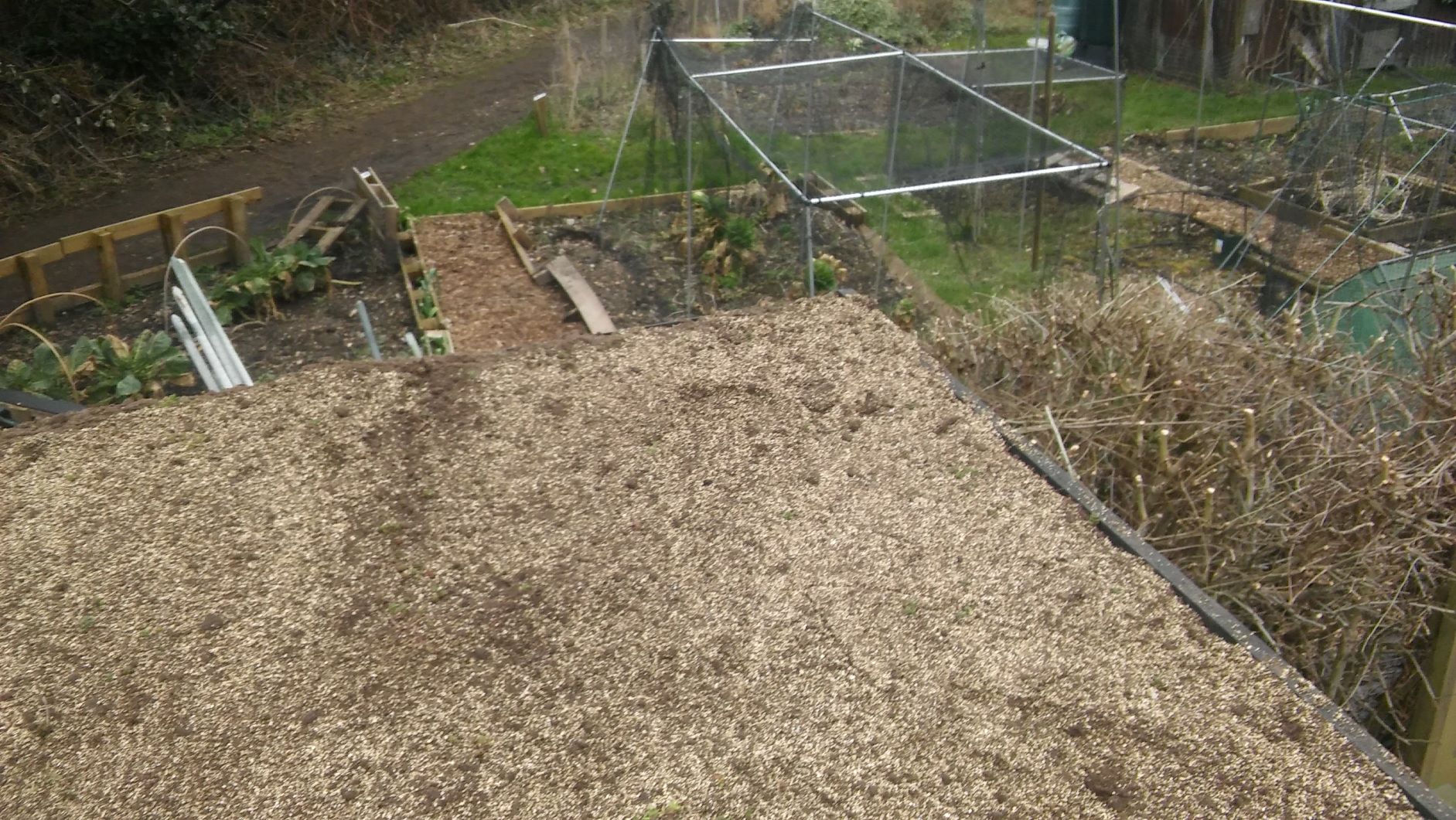
Our leaky old flat roof on the black shed has now been replaced with a new, sloped green roof. Just like when the much-needed dustbin lids for our rhubarb forcing bins turned up on the towpath exactly when needed, green roof sedums were found dumped on a piece of land just when the roof was ready to plant. 

...with a new, sloped green roof!

Firstly, we covered the roof with a pond liner, followed by the addition of soil (vermiculite mix). The third picture below shows the green plants, transported in the van to the final destination: our garden!

We also put up a bird box at the back of the black shed, facing into the hedge, so fingers crossed for a load of healthy chicks to go with our bee cocoons in the bee home on the side of the shed. 

Our bee harvest this year was 43 healthy mason bees, 16 unknown cocoons (see the picture below), four resin bees and seven straws full of bees, which cannot be seen, but some have used mud and some resin. It will be interesting to see if they emerge well...

It looks like there may be two types of mason bee in the wooden blocks, as some tubes had smaller cocoons than others; Charlotte thinks the unknown cocoons might be some sort of parasitic wasp.

This is the first year we have had resin bees in our bee home and we're sad to say that when the straws were removed, the four resin bee nests in the wooden block broke. They were also stuck and the little pupae inside are very delicate. 

If we have any next year, we will just leave them in situ. Luckily, we seem to have more resin bees in the straws we put in some of the tubes. The resin bees use tree sap for making their nests and seem to overwinter in the form of a softish pupae, whereas the mason bees overwinter as dormant adult bees inside their cocoons, which are pretty strong. Here's hoping we have another good harvest next year. 

                                                                     
This blog post was created by Michela, who is currently participating in the Duke of Edinburgh - bronze award.