Monday, 27 April 2015

Spring, lovely spring - the garden in April

This year we didn't get too many April showers and with the polytunnel up and running, volunteers have been asked to do a spot of watering.... Click on photos to enlarge them or see a slideshow.


Preparing beds outside

Polytunnel growing

Making a human scarecrow?

Building a herb spiral


Here are a few photos taken this month. As you can see we now have some little gardeners and they love playing with the sticky weed!


Saturday, 18 April 2015

A local wildlife project & we still welcome volunteers!

Everybody in Cambridge knows about CCF and Transition Cambridge events, but during the holidays, through a workshop on native snails run by the Zoology Museum (sadly still closed as undergoing major refurbishment) I have found out about the OPWP wildlife project run in the Orchard Park development area, in North Cambridge.

Orchard Park Wildlife project

The reason I have chosen to feature it here is that like us, OPWP is aiming to improve Orchard Park for people and wildlife through community action. You can find information about OPWP on its blog, opwildlife.wordpress.com and see the progress of this local project in the archives. 


 in late 2012: "We had our first activity in early 2013. I have worked in international conservation for many years before embarking on an MSc in Natural History Filmmaking in New Zealand and then moving to an MSc in Science and Society with the Open University in the UK. 

"OPWP is run by volunteers and is not for profit. We raised funds last year from South Cambs District Council and the Cambridgeshire and Peterborough Biodiversity Partnership Fund to have a Habitats Management Plan for Orchard Park written by the Wildlife Trust for Bedfordshire, Cambridgeshire and Northamptonshire. This plan guides our monthly activities and we're always happy to welcome new people in getting involved. We're grateful for other support by the Orchard Park Community Council and Histon Police Station Safer Neighbourhood Team Community Fund."

So if you live near this area and if you want to participate, please check out opwildlife.wordpress.com  and leave a message of interest addressed to Mandy. 

Back to our Community Garden, we still welcome volunteers. The garden is looking lovely and the polytunnel is full of trays of seedlings. 

PS. Despite a lot of views, nobody entered last week's competition. So I guess we will be eating the prize tomorrow! The culprit was the pheasant.

Friday, 10 April 2015

Whodunnit in the garden... local competition

The scene of the crime

One of our prize veggies has been nibbled hard. Who did it? The suspects...


A fiendish pheasant?
A sneaky snail?

OR a slimy slug?


Who did it? Best guess gets a surprise prize*. Answer next week. Leave a comment to enter the competition.

*Prize to be collected in Cambridge. Please state your age (if 18+ or child's age) so prize is suitable. Photos: Charlotte and Wikimedia.

Tuesday, 31 March 2015

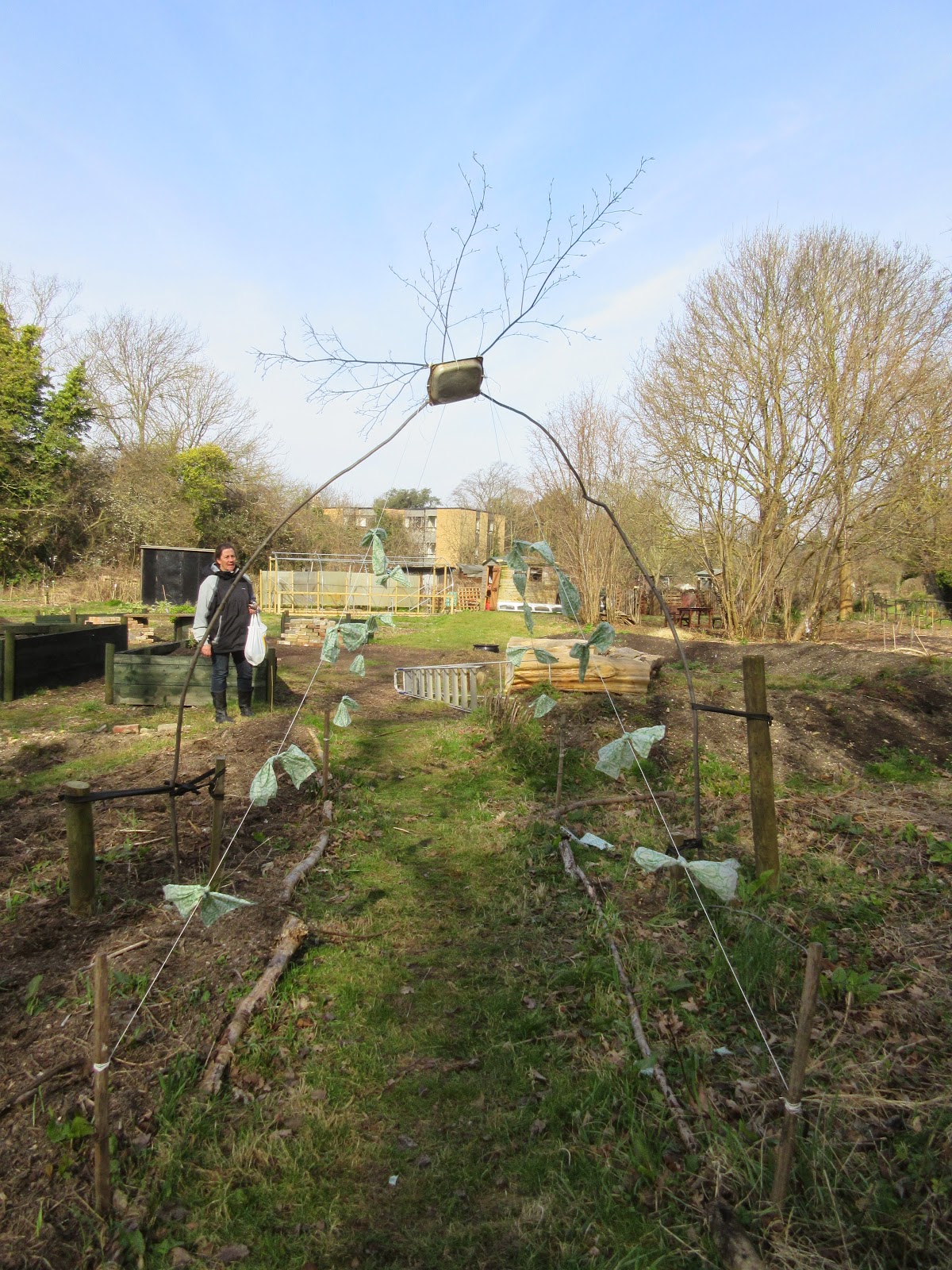
Inosculation at Empty Common Community Garden


Ino what? You might ask. In the photos above, Susanna held two tree trunks together and tied them to an aluminium baking tray, which had holes drilled into it. She then sliced a little off the trunks where they joined so their cambia were in contact and taped the whole lot tight to keep out the air and help stop the joining tissues from moving against each other. 

The pretty green bows made with plastic bags stop the whole tree structure waving around too much. If you want to have a go at inosculation, here is an article with a few more examples... click here to read it.

The blog (not the garden!) is taking a holiday break so we will be back the Sunday after next. Happy Easter everybody!

Monday, 23 March 2015

Polytunnel party!

On Sunday we celebrated the erection of the polytunnel. Thank you to the building team for such a sterling effort! Just click on the pictures to enlarge them.


The new addition to the garden, next to the new shed and
the old shed peeking behind


Our sharing box, facing a busy footpath

A view of the Empty Common Community Garden
from the public footpath


Another view, including some of our raised beds

One of our young members, busy planting


Getting our party started, wood-burning kettle
for our tea outside, of course!
If you like what you see, please join us! Read the first post of this blog to find out where we are and how to join. It's free, fun and we are very inclusive.

Monday, 16 March 2015

More gardening jobs for March: mulching

Mulching with pine needles - pic courtesy of Wikimedia

As the volunteers are still hard at work on the polytunnel here at the Empty Common Garden, many of us might have given their lawn the first cut of the year.

It's also time to mulch the borders. Most people would use compost (own or bought). Mulching helps to suppress weeds and keeps moisture into the soil while forming a barrier for weeds. At the Empty Common Garden we have also used cardboard, which you bury in your veg plot, then plant seeds on top. It helps with weeds and keeps moisture locked in the soil.

Some gardeners use grass clippings. Aside putting a bucketful in the compost bin (not too much as you want a mixture of organic matter), you can use them to mulch. Apparently raspberry canes can do with some mulching at this time of year, so you could build a lawyer around the cut-down stumps using grass clipping. I am sure grass clippings can be used for other tasks. If you have a tip on mulching, please leave a comment!

Monday, 9 March 2015

Snail and slug control

Snail - Wikimedia
Last week, we mentioned stocking up on snail and slug control products. March and April are wet months in Britain and these garden pests can become a problem. And no, it's not OK to throw them over the fence into your neighbour's garden or allotment. So here is a collection of ways to protect tender, green shoots from slugs and snails.

Slug - Soil-net Library
Snails can look cute and slugs are interesting to watch if you are a child, but for gardeners they are a yearly challenge. When all your carefully planted seedlings have been munched and you are left with bare earth and chomped tendrils, many gardeners will feel frustrated if not angry. So there are those who will squash such pests under their wellies or go on recces early in the morning and bag all the snails, then throw them away. The latter approach is brutal but effective if the garden or plot is infested with slugs and snails. Or you might want to encourage birds into your garden, frogs and any other animal that will deal with the pests for you. A toad can eat up to 100 slugs a night!


Other ways to deal with garden pests

Apparently, according to Amateur Gardening, slugs tend to live within an area of 4.8m in diameter, so you don't need too many traps to cover a small garden or plot. For this reason many gardeners have switched from pellets to traps. Other ways to deal with snails and slugs include:
  • Nematodes: eelworms that enter slugs and reduce their reproduction. Once the population of slugs dwindle, these worms will return to natural levels.
  • Copper barriers: rings are sold but you might have some copper tubing laying around that can be used to ring-fence your raised beds or planted areas.
  • Pellets: they are made to be unattractive to birds and other wildlife (hence the blue colour), but you will need to reapply them after heavy rains and some gardeners don't feel comfortable using them.
  • Beer traps: bury a jar or yogurt pot to its rim, fill with cheap bear and cover it so rain doesn't dilute it.
  • Half a melon/orange/grapefruit, flesh scooped out and placed on the earth to form a 'little home'. Come back the next morning and you might find some visitors attached to the domed walls.
Do you have any tips to share? Please leave a comment.